The first Saturday of the month, from March through October, the parking lot behind the Richmond Hill History Museum fills with engines before the coffee is even poured. Classic trucks, restored muscle cars, the occasional tractor someone's grandfather kept running out of spite. Nobody standing in that lot is thinking about the building behind them. But the building is the whole reason the ritual makes sense.
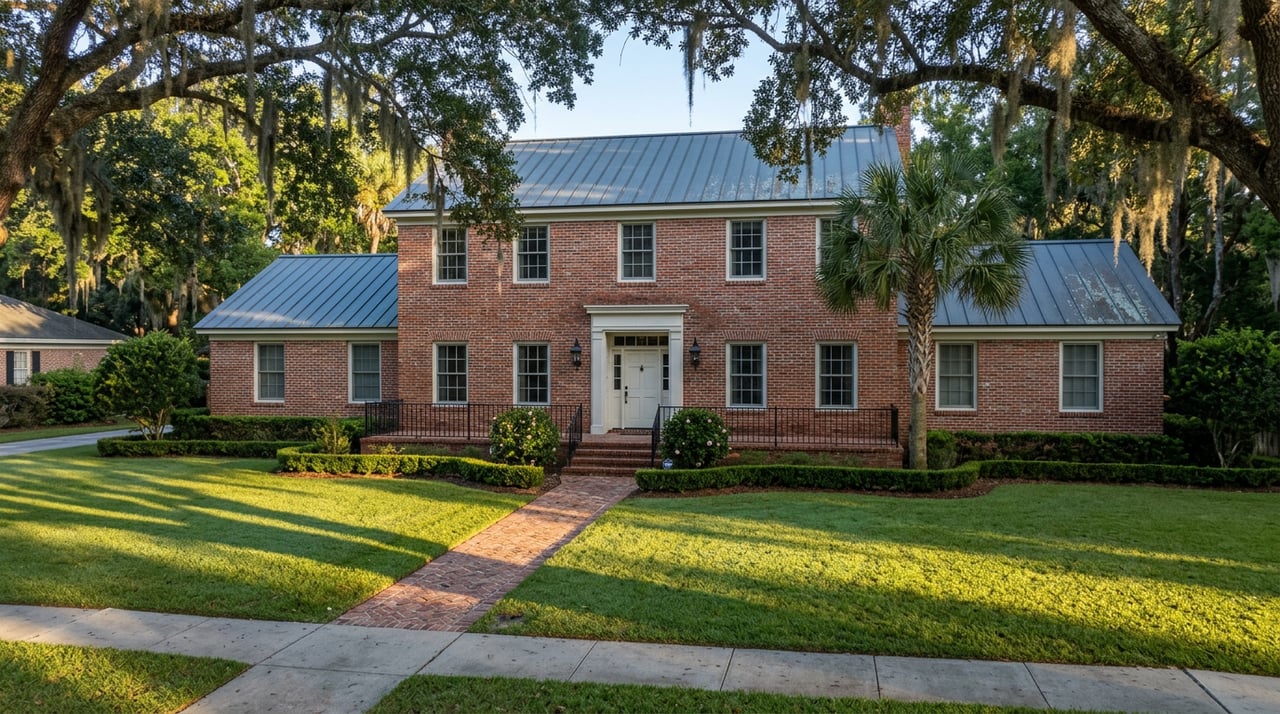
That museum used to be a kindergarten. Henry Ford built it in 1937, part of a rural improvement project he ran on the land he owned around what's now Richmond Hill. Ford's fingerprints show up again at the park where half the town runs its dogs, and again at the Civil War fort nine miles southeast of town. Once you notice the pattern, the town's whole weekend stops looking like a list of separate errands and starts looking like one loop that keeps crossing back over the same man's old footprint.
A Kindergarten Building That Now Smells Like Motor Oil
Cars & Coffee runs the first Saturday of each month, March through October, from 9 to 11 a.m., on the grounds of the historic Henry Ford Kindergarten Building at 11460 Ford Avenue. The building now houses the Richmond Hill History Museum, which walks visitors through the town's story from the Guale people through the plantation era, the Civil War, and the Ford years that gave half the streets their names.
The event itself is unglamorous by design. Bring a car if you have one worth showing. If you don't, bring a folding chair and a kid who likes shiny bumpers. Nobody's selling anything. It's free, it's outdoors, and it ends by 11 so the rest of the day is still yours.
The Rice Field Underneath the Running Trail
J.F. Gregory Park sits on 335 acres in the middle of town, and most of that acreage is a 300-acre rice field that predates the Civil War. The three-mile walking and biking trail that loops the park doesn't skirt the old field. It runs along the top of the dike that once held it in, which means every lap around Gregory Park is also a lap around a piece of antebellum agricultural infrastructure that's been quietly doing park duty for the last several decades.
Past the dike trail, the park holds a lake, a canoe and kayak launch, a birding tower, and the John W. Stevens Wetlands Education Center tucked in the rear of the property. The birding is specific enough to have its own reputation among people who track this sort of thing. Wood ducks, ruby-throated hummingbirds, green herons, swallow-tailed kites, bald eagles, and prothonotary warblers show up on the Georgia Birding Trails listing for the park, with the warblers best spotted between April and June.
Two of the buildings inside Gregory Park are restored Henry Ford–era homes, sitting on a rice dike Ford never touched but land he absolutely did.
That's the detail most people miss walking the loop. The homes aren't relocated museum pieces. They're original structures from Ford's time in the area, kept where they stood.
The Same Man Rebuilt the Fort Down the Road
Fort McAllister was built in 1861 to guard the Ogeechee River approach to Savannah. Union ironclads attacked the earthwork seven times and never took it by sea. It finally fell in December 1864, overland, closing out Sherman's March to the Sea. After the war it sat in disrepair for decades.
Henry Ford bought the site in the 1930s and restored it at his own expense, opening it to the public before the state ever got involved. It became a Georgia state historic site in 1963 and landed on the National Register of Historic Places in 1970. The earthworks, the hot shot furnace, and the bombproof barracks visitors walk through today are largely the shape Ford's restoration left them in.
The fort isn't a static stop. Georgia's state parks program has Fort McAllister running a full slate of events through 2026 as part of the statewide America's 250th commemoration, and the fall calendar has some specific texture worth knowing before you show up:
- Ranger-guided fort tours run Wednesday through Sunday at 2 p.m., with a four-person minimum, so it's worth calling ahead to confirm the day's tour is on
- Rotating craft and history demonstrations cover blacksmithing, hand-dipped candle making, and Civil War-era medicine, each staffed by a historian in period dress
- A Rice Hike traces the property's earlier life as the McAllister family's rice plantation, before it was ever a fort
- A Cast Netting 101 session ran on the park's calendar this past August, teaching the traditional lowcountry technique with gear the park provided
None of this requires a special occasion. It's just what the fort does on a normal weekend, the same way Ford left it running.
Where the Loop Ends After Dark
The Saturday habit doesn't stop at 5 p.m. It moves to the handful of local kitchens that have built their own version of a neighborhood ritual. The 5 Spot describes itself as Richmond Hill's neighborhood kitchen and bar, and it backs that up with an M-F happy hour from 4 to 6 p.m. and a standing practice of giving a portion of monthly sales to a local charitable organization. Grit + Grain runs the other end of the strip with Southern plates and a cocktail list built around its partnership with the Crafted Cocktail Company.
Fish Tales, out on Fort McAllister Road, leans into the dog-friendly side of the loop. It hosted a Yappy Hour for National Dog Day this past August and served as the site for the town's Labor Day fireworks earlier this month. None of these are chains, and none of them are trying to be. They're built for the person who's already been to Cars & Coffee, already walked the dike trail, and just wants dinner without driving into Savannah.
The Loop, Not the List
Strip away the calendar and what's left is a pattern. The car show happens in a building Ford built for kindergartners. The trail runs on top of a rice field his money helped preserve as parkland. The fort down the road stands today because he paid to rebuild it before the state ever stepped in. Three separate weekend habits, three separate properties, one thread running under all of them.
That's not a coincidence worth mentioning once and forgetting. It's the reason Richmond Hill's public spaces feel connected even though they're strung out along Ford Avenue, Fort McAllister Road, and Highway 17 with plenty of distance between them. The town didn't design its weekend around a theme. It just kept using the same land the same man happened to leave behind.
If you're the kind of resident who's already found your way into this loop, you already know most of this by feel. If you're new to it, or thinking ahead to what a Richmond Hill address is actually worth holding onto, Oliver Group knows this stretch of Bryan County the way a neighbor does, not the way a database does. Reach out when you're ready to talk about what your corner of it is worth.